

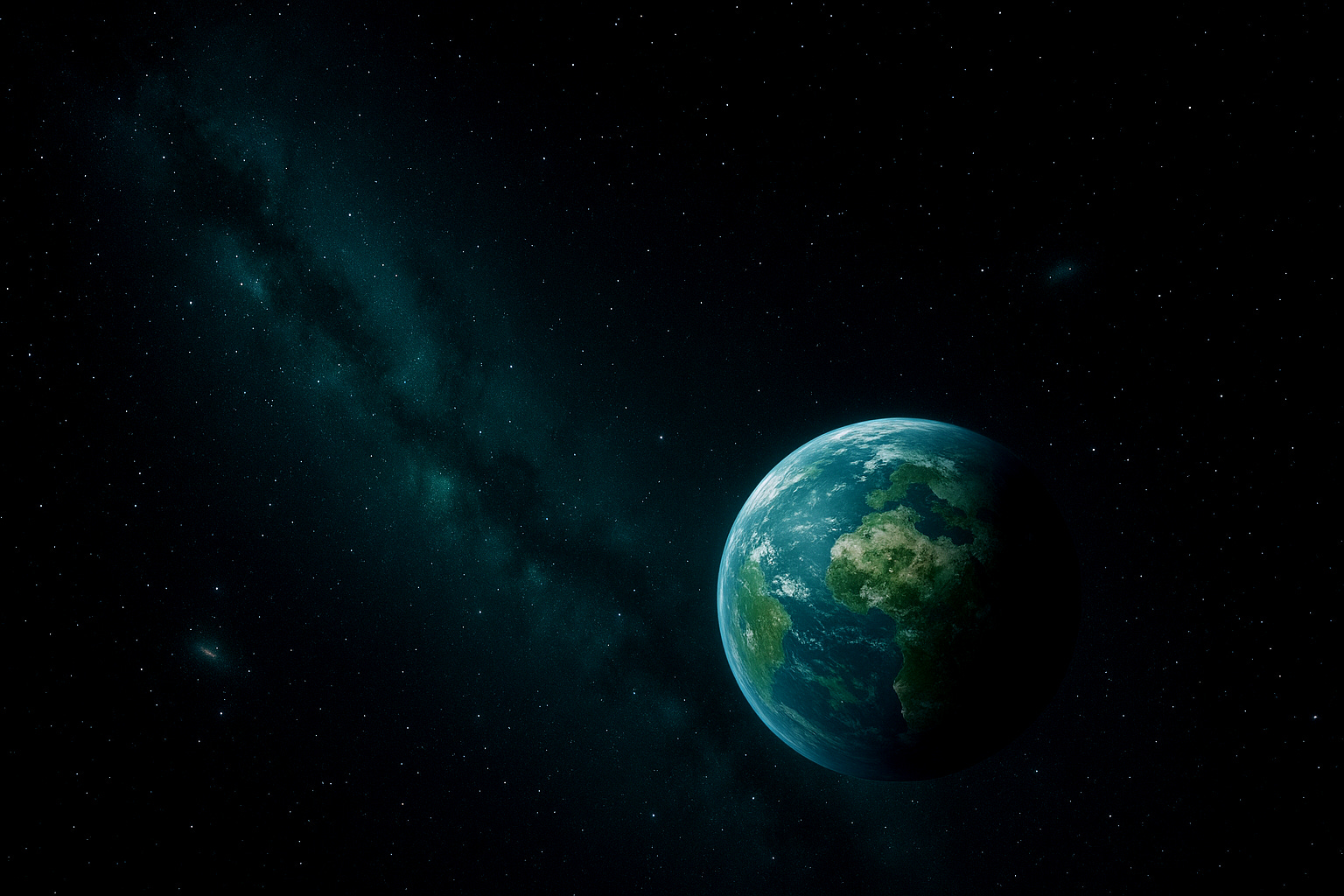
In the articles for this newsletter, I typically pick a topic that seems relatively small, then explain it and try to show its wider ramifications and broader interest. In effect, I build out. This time I will take the opposite approach: I will start with a big topic and work down to some of the details. My big subject today concerns the Universe and the last several billion years, hence covering a lot of both space and time. The subject is given in the title above, “Are we (that is us humans) alone in the Universe?” Of course, short of being visited unambiguously by intelligent aliens, we cannot know. Hence we should perhaps modify the question: “are we probably alone in the Universe?”
Even with that change, we still need to clarify the question. Specifically, whom are we talking about when we say “we” and what is meant by “alone”? Different answers to those questions will be framed by different individuals, hence let me explain what I have in mind. By “we”, I do not mean human beings per se since it is very unlikely that our species could have arisen by natural processes of evolution more than once even in a space as big as the Universe. Human beings, we can be sure, are unique to Earth. What I mean by “we” is conscious, intelligent animal-like creatures, capable of movement and doing things, whom we humans would recognize as fellow sentient creatures even if their appearance and anatomy looked quite different from any animals we know of on Earth.
And by “alone” I do not mean to ask whether we are unique in that character in the Universe but only extremely rare. Thus, if there were only 5-10 planets in the Universe that had sentient, animal-like organisms, I would be willing to state that such creatures as ourselves were highly unusual in the Universe. Whereas, if there are millions of planets with such complex living beings, this condition would not be rare but (relatively) common. (We will come to the matter of numbers of possible planets on which such life might have arise and exist in a moment.)
Short of visits by intelligent space aliens, how does one even begin to think about this topic? We can do so by making some inferences, then extrapolations, from what we know of the requirements for animal life on Earth. Although the forms of animal-like creatures (I use the word “creature” in a loose sense, without the Biblical connotation of creation by a supernatural being) could and almost certainly would be very different from those on Earth, we can be fairly certain that the temperatures that would permit animal life anywhere to arise, thrive, evolve, must exist only in a certain narrow range. Thus, animal life could not have arisen or exist on stars, which are far too hot. Nor could they exist on planets of intense, perpetual cold, well below the freezing point. It is reasonable to believe that animal life can only exist on planets within certain so called “habitable zones”, areas surrounding the stars that these planets orbit. In our own Solar System, our planet clearly exists in such, while Mercury does not, Venus is too hot for its own reasons, and Mars is, at best, on the edge of the habitable zone and probably too cold. Let me stress again that we are talking about animal life, not microbial life, which we have known for more than 50 years, can, in some forms, exist under conditions that were once regarded as extreme. Animal life is of sufficient complexity to have requirements that simpler, microbial life forms as a whole do not have, hence a narrower range of environments in which it could have arisen.
Second, it is hard to imagine animal life existing without being based on complex molecules, so called “biomolecules”, that are special to living things, not found in rocks or on barren surfaces inhospitable to sustaining living things. Such biomolecules are almost certainly carbon-based. We know of no other element that could plausibly be used to build long chain-like molecules. (Silica, at one time, was imagined to have this capacity but is no longer deemed to be right for being the basis of biomolecules.) Hence, a planet capable of supporting animal-life would almost certainly have to be carbon-rich. Furthermore, it would almost certainly have to be water-rich, a probable requirement for the start of life in even the simplest forms.
Please note that this is already narrows down considerably the possible number of planets on which animal-life might arise and be sustained.
One last probable requirement: animal life on Earth is based on the small biological unit we call the “cell”. I find it inconceivable that any form of animal life would not be so. The alternative would be large fluid-containing biological structures but those could not have either the capabilities for directed movement or manipulation of objects that are characteristic of and make complex animal-life possible. Hence, I feel that it is safe to predict that if animal-life exists beyond Earth, it too will be based on cells (though of course not identical to the cells that we and our fellow animals on Earth are made up of). This point will be the focus of part II of our Inquiry.
Before we try to estimate the frequency of planets on which intelligent animal-life might have arisen, let us give some historical context to the question. For millennia in Western culture, at least, it was assumed that at least intelligent creatures at the level of human beings did not exist elsewhere. The classic Judeo-Christian belief was that human beings were uni1que in what was called Creation and that planet Earth was its actual physical center. Not every person or culture believed that but it was the dominant belief in Europe for at least 1500 years.
What changed that belief was what we now know of as the Copernican Revolution, the idea that the Earth was part of a Solar System of planets that revolved around our home star, the Sun, and that neither the Sun or our planet was the physical center of the Cosmos. Accompanying that idea was the so called Copernican Principle, the idea that there was nothing special about our planet or indeed the Solar system, that in a mid-20th century phrase, we were just the “third rock from the Sun”. The Copernican Principle, also referred to as the Principle of Mediocrity, decentered us, making us, and Earth, less special in the Universe. In a real sense, that was genuine intellectual progress although it was difficult for many in Western societies, raised on beliefs in the story of Creation in the Bible, to accept.
What grew up in the wake of the Copernican Principle was the idea that there might be many other places in the Universe where not just animal-like but human-like creatures, capable of building civilizations, might be not uncommon. The great 19th and early 20th century astronomer Sir Percival Lowell even imagined that certain long lines he saw on planet Mars, through his telescopes, were canals or remnants of canals built by creatures on that planet.
Indeed, that gave rise in 1950 to what became known as the “Fermi Paradox” after Enrico Fermi (1901-1954), who formulated it. Fermi’s assumptions were that: 1) Life should have been capable of arising on many planets throughout our galaxy; 2) that once living things arose, it was just a matter of time before intelligent creatures evolved, 3) that once the latter existed, it was just a matter of more time before technological civilizations came into being, and 4) that with the latter, travel by them through vast reaches of space was also inevitable. Fermi and his colleagues felt that all this was reasonable but it left them with a question: why was there no evidence on Earth of the existence of such space aliens? Shouldn’t we have received visits from them or at least radio wave traces of their civilizations? This was the “paradox”: such beings and their civilizations should be common, or at least not rare in our galaxy but there was no actual evidence for such. 1
This speculation was followed 11 years later by the formulation of the “Drake equation”, which showed, in principle, how, with a few assumptions about probabilities of seven variables, concerning component steps, one could do a rough calculation of the probability of the existence of advanced civilizations capable of the requisite degree of space-travelling capacity. 2
There was nothing wrong with the basic logic of the Drake equation, as far as we can see today. In principle, the chances of there having evolved other advanced civilizations in our galaxy, and beyond it, in other galaxies, should simply be the multiplied probabilities of the component steps that would have been necessary for advanced animals on other planets to arise and start exploring Space.
The actual problems with the Drake equation were two-fold. First, there were no reliable data/values for any of the seven variables. Basically, one had to make educated guesses about their values. Second, it was entirely possible that other critical factors had been left out of the thinking that went into it. In other words, the idea that there were only seven potential rate-limiting steps in the progression toward civilizations that could do space-travel and cover big (galactic-level) distances was every bit as much an optimistic assumption as the simpler, qualitative thinking that lay at the basis of the Fermi paradox.
Indeed, in the 64 years that have elapsed since its formulation, even in the first 40 years, the realization that a lot was left out of that calculation has been the major advance in thinking about this difficult but intriguing question. These additional factors, individually and collectively, mean that Earth was actually a particularly favorable place for complex living things to have originated and evolved into even more complex organisms, animals such as ourselves that can venture into space and, perhaps, even eventually undertake interstellar travel. To date, however, we have only managed space voyages within our own the Solar System, albeit ones that would have seemed marvelous even to the 20th century scientists who designed the first space rockets.
This thinking about all the additional factors that made the evolution of complex animal life-type forms was first laid out and summarized in a book first published in hardback in the year 2000, and initially in paperback in 2004. The authors are two scientists at the University of Washington in Seattle, Washington, named Peter D. Ward, a geologist and paleontologist, and Donald Brownlee, a professor of astronomy. Their book is entitled Rare Earth: Why complex life is uncommon in the Universe. 3
To help orient the reader at the start, Ward and Brownlee list, at the front of the book, 18 critical factors that contributed strongly to the chances that Earth would be favorable terrain for the evolution of complex animal life-forms. They then discuss and explain them in detail in the book.
It is not clear that all would be necessary for such evolution on all other planets. Indeed, it seems likely that not all would be required. However, many would be very helpful at least. Conversely, planets that did not have such factors might have had greatly diminished chances of supporting the evolution of advanced life. We have already mentioned a few requirements, in particular that the planet be both carbon-rich and have plenty of water. Those two requirements alone would eliminate many, many planets as places where complex life might arise.
Keeping this essay to a reasonable length precludes going into this material in the depth it deserves but I would like to mention a few of the factors that Ward and Brownlee discuss because they might be surprising. One is the tilt of the Earth, as it orbits the Sun. This permits the existence of seasons, which in turn would prevent large areas of a planet from experiencing temperatures that are either too high or too low to support advanced animal-like life. A second feature on Earth that almost certainly contributed to the evolution of complex life forms was plate tectonics. The geophysical churn that such movements can contribute to the shaping of a planet’s surface and outermost layer would have been highly favorable to biological evolution and ultimately to the origins of animal life. Again, only a small fraction of the planets that might have had conditions permitting origin of primitive life forms, namely early prokaryotic-like cells, have the requisite axial tilt or the existence of plate tectonic movements.
Another factor that would have been necessary is sufficient time. Please recall that planet Earth is an old planet, estimated to be 4.6 billion years old, about a third of the estimated age of the Universe and it has taken that long to produce a complex animal that is now capable of space travel, though not yet the kind dreamt of by Fermi and others. To have that kind of time requires a parent star that has had a long life. It turns out that our Sun is not just a mediocre, average sort of star, but one that is in the top 5% of all stars in terms of size. Its size, in turn, means that it did not burn out before any of its orbiting planets could evolve complex life forms. This fact too urges us to appreciate how special Earth’s situation may have been, in respect of our parent star, as a potential seed bed for complex life.
Can one turn this vague appreciation, however, into any sort of numerical probability concerning the likelihood of complex life in either the Universe as a whole or, thinking a little more locally, just the Milky Way, our galaxy? One can because we have estimates of the likely number of planets and of the fraction that would lie in habitable zones around their stars.
Let us think comparatively small and just focus on our galaxy. It is estimated that there may be up to 5 x 10¹⁰ planets in the Milky Way. That is a large number. However, probably only 1% are in the habitable zone around their stars, which reduces the number to 5 x 10⁸. That still seems like a large number – 500 million -- but what fraction would have the requisite requirements?
Let us imagine that a mere 12 of the 18 factors Ward and Brownlee name as highly favorable for evolving complex organisms would be sufficient for doing so. Let us also take as the probability that any planet has a 1/10th probability of having a particular variable; this might in fact be generous. The probability of a given planet having all 12 would then be (1/10) 12. That is a very low number. In fact, taking it seriously means that there might not even have been one planet in our galaxy capable of supporting complex life. Since we know that one has been so capable, we can see how rough the calculation is. Still, the assumptions are reasonable and the result makes it very unlikely that our galaxy is home to lots and lots of complex creatures, let alone space-travelling ones.
Beyond that, where does this thinking leave us? It asks us to think again about the Mediocrity Principle. Four to five centuries ago, it was a reasonable inference and, at the time, a justified one. In terms of our understanding of the Universe, it was far more realistic than the beliefs that preceded it. Yet, perhaps it is time to rethink it. Earth is not so mediocre. Indeed, it may have been super-special in its history and its ability to support complex life forms. As such it may be quite rare in the Universe. We may not be strictly alone in it as highly sentient creatures, capable of building civilizations, but we indeed might be quite lonely. Life at its simplest levels may be common in the Cosmos, but organism like us? No, we probably are very unusual.
There is a further argument, quite different from anything in the above, which strengthens that conclusion. Yet, this article is already long enough. Hence, I will return to this other consideration in part II, fairly soon. The point of doing so is not to completely dissolve or further weaken the Fermi Paradox but because the material is simply quite interesting in itself and worth knowing about.
Enrico Fermi, the originator of the Fermi Paradox, was a remarkable man, a Nobel Prize laureate in physics at age 37. He was one of those rare physicists who are both brilliant as a theoretician and gifted as an experimentalist. Today, primarily remembered for having invented the first nuclear reactor, with controlled uranium fission rates, which in turn helped inspire the Manhatttan Project, his discoveries and accomplishments went considerably beyond that. The Fermi Paradox apparently arose spontaneously out of a lunch-time conversation at Los Alamos one day in 1950. He and his colleagues had been discussing what they saw as the high probability of civilizations in the galaxy, when Fermi blurted out, “Well, where is everyone?” meaning the presumed space-travelling aliens.
Frank Drake, who developed the Drake equation was an astronomer who was very involved in the radioastronomical search for extraterrestrial life (SETI). His equation derived in part from prior discussions with a small set of distinguished colleagues, perhaps the most famous of them being Carl Sagan. Despite all the uncertainties in the Drake equation, Drake and Sagan estimated that there might be between 1000 and 100, 000 civilizations in the Milky Way capable of space travel.
See Ward, P.D., and Brownlee, D. (2004). Rare Earth: Why complex life is uncommon in the Universe. New York: Copernicus Books. It is a great read, highly recommended for those interested in the subject.
Adam, I fixed the problem mentioned below: I hit the "upgrade to paid" button and resubscribed with my new debit card number. At first, the system declined my card, but it seemed to work on the second attempt. When you have the time, please check that the system accepted my subscription. Thanks. Dan
Adam, It seems that your system has lost my status as a paid subscriber. This may have been due to a recent cancellation of my old debit card. We can discuss this on our next virtual meeting. Dan