

A few weeks ago, I wrote a piece with the above question but it gave only a partial answer. It concentrated on the features of our planet, Earth, that have made it an exceptionally favorable place for evolving sentient, complex, animal-like creatures like ourselves. My provisional conclusion, from those considerations alone, was that if we were not strictly alone in the Universe, as such creatures, that we were probably highly unusual in that respect, hence rare. In other words, the provisional conclusion was that the Universe is not crowded with living beings with our capabilities, as had been imagined and predicted by some very smart and knowledgeable people a few decades ago. In this piece, I want to go into another set of considerations, quite different in nature but which reinforces that conclusion. This concerns the special biological reasons for thinking that the evolutionary path toward sentient, animal-like organisms on Earth was probably an usual and quite lonely one.
Before getting into that new material, however, let me briefly recap one particular point that is relevant to it which I mentioned briefly in the earlier piece. This is that any complex organism capable of doing complex things (e.g. manipulating objects, moving our bodies from one place to another), like us and even the simpler animals such as insects and earth worms, let alone the more complex ones such as birds and wolves and whales, almost certainly must be constructed of biological cells. Having cells as the basic building block allows all sorts of specialized features to exist and to evolve, over long periods of time, in a way that any solid, non-cellular, or liquid-containing animate entity – if such could exist – would not. At least, I cannot imagine any alternative to a cell-based construction of animal-like life for an organism to do complex things. That is not the same as saying that it is impossible but I have thought about this a lot and believe that my conclusion is correct. (Other opinions from readers would be welcome.)
If we accept that premise, however, that leaves the question: what kind of cell would be a favored building block for an animal-like creature? A priori, since the Universe is vast and not really known in detail to us, there might be all sorts of possibilities, many of which we might not be able to imagine. However, we can at least take some guidance from our own planet, where we know something about the kinds of cells that exist here, how they evolved, and how they relate to the kinds of organisms that we have here, especially the most complex kinds, animals and plants.
Fundamentally, despite all the millions of species of living things and the diversity of their cells, there are only two major kinds of cell here on Earth. The first are relatively simple in construction, generally much smaller than the second kind and are termed “prokaryotes”. The second kind are larger – by a typical factor of 1000-fold in volume – and more complex; these cells are termed “eukaryotic cells” and organisms composed of them are called “eukaryotes”. The differences that are regarded as defining them as distinct, however, are not their size or over-all complexity but their genetic material, its relative amount, and how they contain it. In prokaryotic cells, the DNA is usually a single circular molecule, which contains all the genes, and this constitutes its “chromosome”. In eukaryotic cells, the total DNA is generally much greater and divided into multiple linear units, which are its chromosomes.
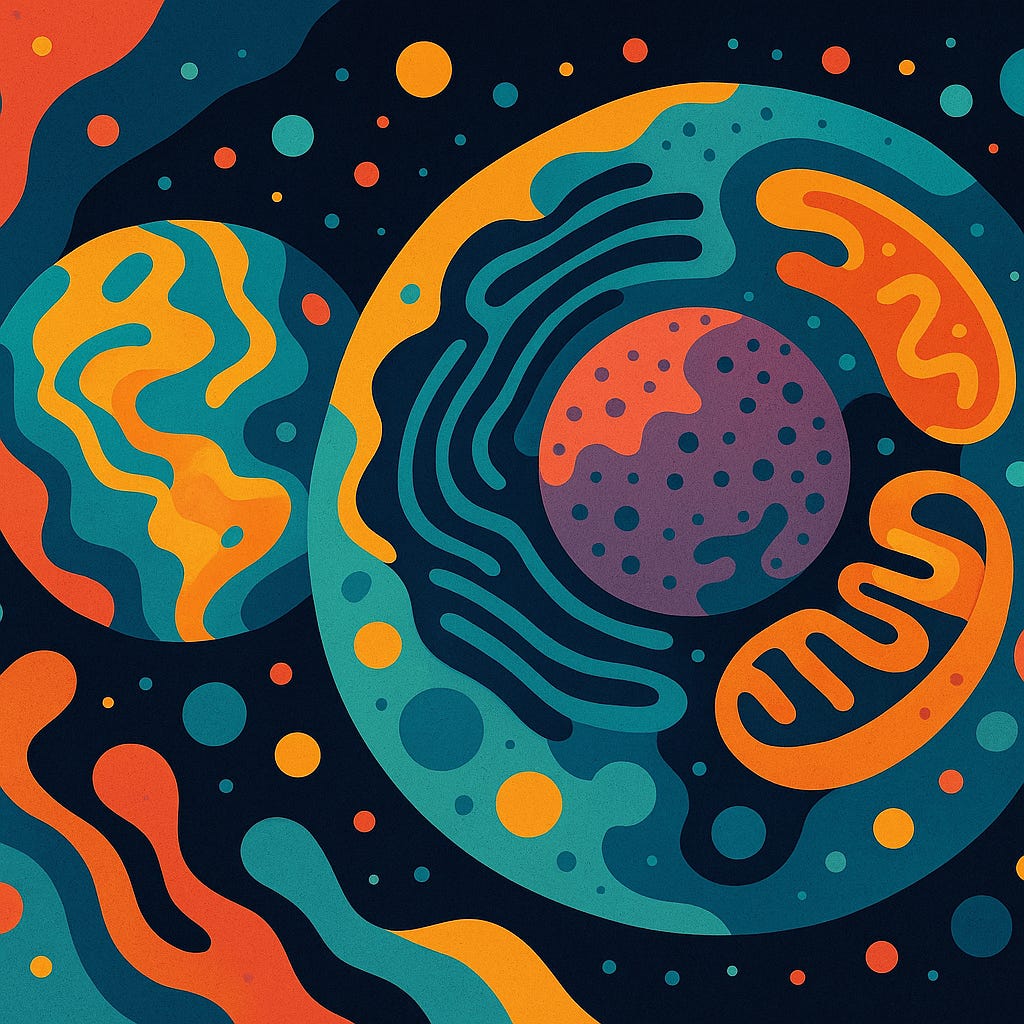
The difference in how they house their chromosomes is particularly crucial. In prokaryotes, the DNA molecule is found directly in the liquid matrix of the cell, its cytoplasm, though probably always attached to the inner side of the cell membrane. In eukaryotes, the chromosomes are contained within a roughly spheroidal, membrane-bound structure termed the nucleus. 1
We tend to think of the life of our world as having its character largely through the presence of animals and plants – picture Earth suddenly deprived somehow of its animals and plants; the image is a very bleak one, basically a Mars with oceans. In reality, prokaryotes (and their viruses) really rule the roost. They do so in terms of numbers of species (though this is hard to give a precise number to) (see What is a “species”? An enduring question) and the estimated relative numbers of these kinds of cells. In addition, though we will not get into this matter here, as this would be too large a digression, they make life possible for us eukaryotes in various ways.
The crucial point – relevant to our question about the rarity (or otherwise) of animal-like life elsewhere in our galaxy or the universe as a whole – concerns the cellular make up of the complex organisms on Earth vs. all the rest. It is an unambiguous difference. All of the complex forms, that is all of the animals and plants, are eukaryotes; none are prokaryotes.
Could this reflect a difference in their relative times of existence, with the prokaryotes not having had enough time to evolve this kind of complexity? The answer is: no. Earth is estimated to have started forming about 4.6 billion years ago, and by 3.7-4.0 billion years ago, the first cells, prokaryotic in structure, had appeared. Eukaryotes, in contrast, only first appeared, as judged by the criteria we have which are not perfect of course, about 2.0 billion years ago. Complex multicellular organisms first appeared about 670 million years ago and unambiguous animal forms, that is organisms we can relate to (some) kinds of animals that exist today by about 540 million years ago. Hence, while prokaryotes have had on the order of 4 billion years to evolve complex organisms, had they been able to do so, eukaryotes managed this trick in “only” about 1.5 billion years. Once the first such had appeared, the stage was set for the rapid efflorescence of complex life forms.
Hence, it is a reasonable to infer that reaching the eukaryotic level of cellular complexity was a prerequisite for being able to generate, via evolution, organisms of the complexity of animals. Of course, there was that temporal gap of 1.5 billion years or so between the appearance of the first eukaryotic cells and the first animals (of the kind we recognize as such), and this is not a small interval of time. Hence being eukaryotic was not sufficient for that evolutionary step but it probably was essential.
That provisional conclusion leads immediately to the question: why? What is there about being eukaryotic that makes possible the potential of biological complexity that is far beyond the capacity of any prokaryote on Earth?
It is probably not having a nucleus per se though that is considered the defining difference between prokaryotes and eukaryotes but something connected to or correlated with it. That something is probably the amount and complexity of the genetic material, both of which are greater, often vastly, greater in eukaryotes than prokaryotes.
This quantitative difference itself needs clarification. It is probably not the difference in gene numbers though defining the “gene” is itself trickier than one would expect (see On how “the gene” gained, then lost its meaning) 2. Hence estimating gene numbers even for the species for which we have the full details of their genomes, is itself imprecise. Nevertheless, putting that difficulty to the side for the moment, consider these differences. The bacterium Escherichia coli, a common resident of the human gut but a true prokaryote, has about 4000 genes; brewer’s yeast, Saccharomyces cerevisiae, a unicellular organism but a genuine eukaryote, has about 6000 genes; the fruit fly Drosophila, a small animal, has about 13,600 genes and; we humans have about 21,000 genes. Clearly, there is no simple relationship between gene number and biological complexity; the fruit fly is surely more than twice as complex biologically as the yeast cell, and we humans must be more than 50% more complex than fruit flies.
Hence, after those gene number comparisons, we are still left wondering: where does the extraordinary biological complexity in different animals come from? This question is probably worth a BioBuzz essay in itself, at some point, but here let us just say that it probably is tied up with the complexities of turning large numbers of genes on and off, and in some cases, way up in the amounts of gene product produced. Such complexities of gene regulation might require a lot more and varied DNA sequence than any prokaryote has.
About 15 years ago, two evolutionary biologists with great expertise in molecular biology and biochemistry, Nick Lane and William Martin, turned their attention to this question and concluded that the much greater biological complexity of complex eukaryotes was indeed tied up with their much larger genome sizes, an argument they spelled out in an article in Nature. However, they went a step further to explore why eukaryotes could have such expanded genomes relative to prokaryotes. They concluded that it was the greatly expanded energy-generating capacity of eukaryotes that made their expansion of genome size possible. 3
An important point in their argument concerns the fact that synthesizing DNA is comparatively cheap in terms of energy. Hence, a greatly increased capacity to make energy, which eukaryotes have relative to prokaryotes, was not an initial prerequisite for increased genome size 4. Rather, they argue that the increased energy needs of eukaryotes has to do primarily with the fact that making proteins is energy-expensive. Hence, the more energy the cell can expend, the greater its capacity for making more proteins, both of individual proteins and in total, including new proteins, ones that prokaryotes do not have. Think for instance of the whole set of specialized proteins required for all the tissue types in the vertebrate body, such as neural tissues, the various gut tissues (which change along the length of the gut), hormone-secreting tissues, different muscle tissues, lung tissue, the liver, the kidney’s, and bones and cartilage. This is a world of molecular and biochemical complexity that the average, or even above-average, prokaryote could never dream of (that is, if prokaryotes could dream.) Eukaryotes as a whole have about 3,000 more kinds or “families” of genes than found in prokaryotes. This constitutes an enormous reservoir of potential genetic complexity to be drawn on.
As part of this greatly increased complexity, Lane and Martin stress the often-greater complexity of the protein-coding genes themselves in eukaryotes vs prokaryotes. Every protein (or “polypeptide”) chain has characteristic small regions, so called “folds”, and eukaryotes as a whole are estimated to have five times more kinds of these folds than prokaryotes. This too should provide eukaryotes with a greatly expanded capacity for different biochemical/molecular activities relative to prokaryotes.
Accepting for the moment the Lane-Martin argument that this greatly expanded realm of protein activities was ultimately made possible by the greater energy supplies of eukaryotes, one may well ask: well, where did the extra energy capacity of eukaryotes come from? The answer is quite simple, namely our old friend, the mitochondrion (see The Billion-Year Mitochondrion Rabbit Hole). The mitochondrion is unique to eukaryotes and is almost certainly the novel feature ultimately at the root of the differences between eukaryotes and prokaryotes, predating the existence of nuclei and the other features that distinguish these two major kinds of cell. The mitochondrion is not only a marvelous biological entity that is superb at generating energy, in the form of adenosine triphosphate (ATP) but is present in animal body cells in numbers from about 100-200 up to 2000 (liver cells). It is those numbers that help ensure, in normal healthy tissues, abundant energy supplies for the things that each cell has to do.
Interesting as all this is – and I hope that you find it so – you may well be wondering: what does it have to do with the question with which we began, the rarity (or otherwise) of complex animal-like organisms in the Universe or even just our galaxy, the Milky Way? To understand the potential connection, recall that mitochondria originated from an initial invasion of one type of prokaryotic cell by another, on the order of 2 billion years ago. There were probably advantages for both participants from early on. The invading cell had found a new home and probably soon began supplying one or more kinds of molecule, perhaps ATP, that were useful to the host cell. Over time, this co-habitation, or “endosymbiosis” became a fixed habit and the invader evolved into what today we call the mitochondrion.
The crucial point is that, from all the evidence and analytical tools at our disposal, this successfully happened only once. All the mitochondria in all the living eukaryotes on Earth today are judged to be descendants of this event. This implies that it was a rare event and rare, in turn, suggests that it was, in some way, unlikely, probably difficult. Think about this: perhaps in about 4 billion years of life on Earth, a successful symbiosis leading to mitochondria may have only happened once, amongst the countless prokaryotic cells that have lived on our planet in this period. Incidentally, this conclusion is not original to me; it comes from Lane and Martin in several of their publications. 5
Let us sum up the entire line of thinking. If living creatures of the complexity of animals found on earth had arisen elsewhere in the Universe, they would, almost certainly, had to have been composed of cells. These cells would, however, must have had a high level of complexity, far more than we see in prokaryotic cells on Earth. Those cells would have required a eukaryotic-level of complexity in order to supply the potential for evolving the kind of organismic complexity we see in animals. Such complexity, in turn, would have required a super-efficient mode of energy supply, of the level that the mitochondrion makes possible.
Does all this necessarily imply that should intelligent aliens exist elsewhere in the Cosmos that they had to have eukaryotic-type cells with an organelle like the mitochondrion? No, because there may be other possibilities out there for energy generation that we haven’t been able to imagine yet. Nevertheless, in terms of our understanding of what made complex life possible on Earth – both the external factors (the cosmic and planetary considerations discussed in part I) and the biological considerations (discussed here), it is reasonable to conclude that while “we” (intelligent animals capable of building things and even space travel) may not be unique in our galaxy, let alone the Universe as a whole, there probably aren’t many of us.
A further thought: if Earth is indeed an exceptional and unusual planet for having allowed creatures such as ourselves to have evolved, perhaps we should be exceptionally careful to make sure that we do not push ourselves, and the rest of animal life on Earth, over the brink into extinction. After all, we might not be able to count on friendly, capable aliens to carry on the work of being amazingly talented living creatures in the Universe should we do ourselves in, whether through nuclear war, climate change, or piecemeal but cumulative environmental destruction.
The suffix “karyote” in “prokaryote” and “eukaryote” refers to the Greek word “karyon” which means “nucleus”. In turn, the prefix “pro” in “prokaryote” literally means “first” but actually denotes such an early state of a nucleus that it actually means without or before there was a nucleus. The prefix “eu” in the term “eukaryote” can be translated as “well” but is understood best as meaning “true”.
For a more detailed treatment of the problem, see Portin, P. and A.S.Wilkins, (2017). The evolving definition of the term “gene”. GENETICS 205: 1353-1364. https://doi.org/10.1534/genetics.116.196956
For the full exposition of their argument, see Lane, N. and W. Martin (2010).
The energetics of genome complexity. Nature 467: 929-934. doi:10.1038/nature09486.
At very large genome sizes, which some eukaryotes have, the energetic cost of replicating all that DNA does become significant, as Lane and Martin discuss. However, these genome sizes would have been a relatively late evolutionary development when eukaryotes would have already had a large capacity for energy-generation.
An excellent treatment of the key role of energy in the evolution of life and that of mitochondria in supplying it is that by Nick Lane (2015). The Vital Question: Why is life the way it is. London: Profile Books. This book discusses mitochondrial origins and why this must have been a rare event. A very good exposition on the relationships between biological complexity in eukaryotes and mitochondria is Part III, pp. 157-233. For a focused discussion on mitochondrial origins, see Martin, William F., Sriram Garg, Verena Zimorski. 2015. Endosymbiotic theories for eukaryote origin. Philosophical Transactions Royal Society B 370: 20140330. doi.org/10.1098/rstb.2014.0330.