

In a prior article, we looked at four factors that influence how each individual develops, including most especially their individual mental/cognitive processes. Those processes depend on a specific organ, the human brain. In this piece, I will examine just how well the human brain performs its job. As the title asks, “Can we trust the human brain?”
This question may seem odd, even perverse, but it has repeatedly been raised in history by major thinkers in the past 2500 years. Before getting into it, however, let us clarify what is meant by “trust”. Here, it refers to reliability. Does our brain provide a reliable picture of the external world? If our answer is “no” or “not really”, then we have to wonder whether we can rely on the brain for anything, such as beliefs about ourselves or how we relate to our fellow humans or whether we can trust our memories. In effect, if you do not believe that your brain delivers up a faithful picture of the outside world, then everything is uncertain in terms of what we think we know.
In contrast to several previous articles where I posed a big question but left it unanswered (such as “what is a ‘gene’?”, “why do we age?”), here I will give an answer. It will not be numerically precise, e.g. “we can trust our brain 57% of the time” (what would such precision mean and how could it be arrived at?), but it will be an answer.
What prompted my reflecting on this was some recent correspondence with fellow biologist-writer Frederick R. Prete, check out his Substack. He had written a piece on people who have some highly unusual views of their own natures, e.g. people who see themselves as being reptiles in human form. He did not dismiss such views as craziness but used them as a starting point to discuss how every human brain generally builds its picture of reality (including of oneself). This starts with sensory data, which is processed by the brain and then combined with memories, to give interpretations of the external reality as mirrored in one’s perceptions. He illustrated this by discussing colours, which do not exist in the physical world as such but which are products of our mental processes. He then elaborated on this with the individuality of our perceptions of the taste of certain foods.
Of course, one can extend this picture of diversity to virtually every other realm of human experience. We know enough about human brains to be certain that every human brain is different from every other and reconstructs (my correspondent prefers the word “constructs”) reality somewhat differently, sometimes dramatically so. Many of the stories given by the late Oliver Sacks explored this reality in his first book about neurological case studies. Again, some of these things are so strange that they almost certainly reflect some degree of pathology but the general rule is true: we each inhabit our own reality, which is created by the workings of our individual brain.1
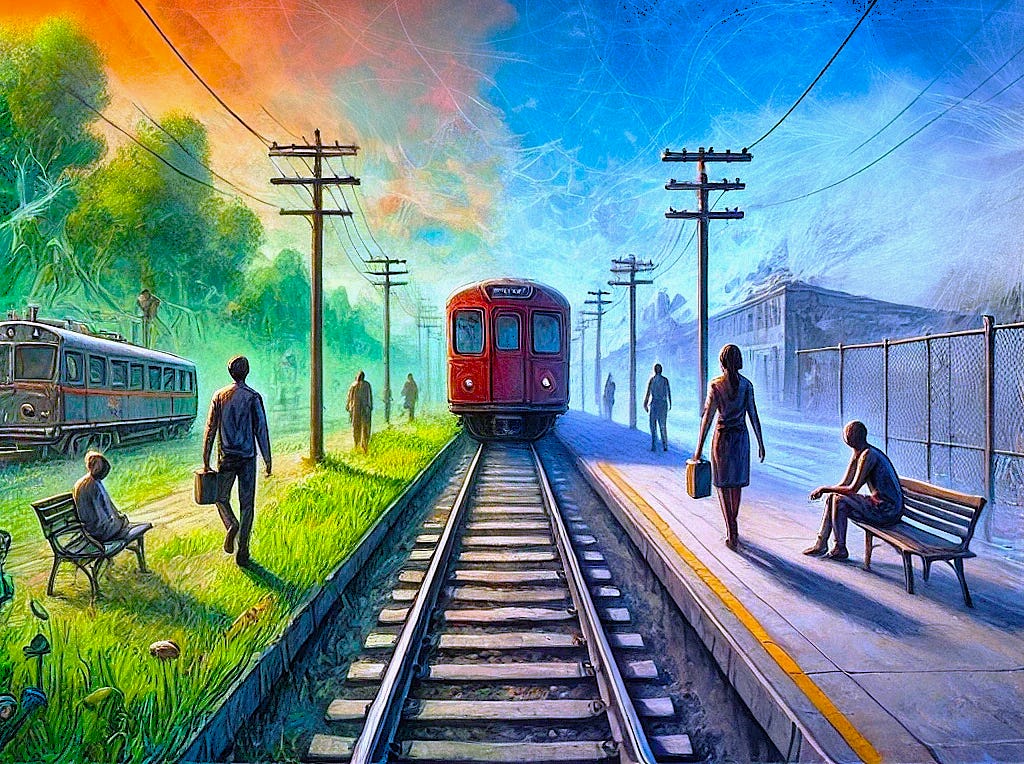
Admittedly, we often agree about something in the outside world and those areas of agreement become our “shared reality”. If, for instance, a friend and I are walking down a railroad track and think we hear a train in the distance and then see it (or think we see it), we would almost certainly get off the track to avoid being killed. We would not have to discuss it; we would just do it. And, as the train rushed by, over the stretch of track where we had been standing, we would feel, again without saying anything, that we had perceived things correctly.
Thus, acknowledging that everyone constructs their own world is not to deny that there is an external reality and that, often, different people will perceive it similarly. The key point is that – as in the case of colours – outside realities are not always direct, highly faithful reflections of those externalities (though, as in this railway example, they can be). Perceptions are interpretations and interpretations are subjective, subject to error and difference amongst people.
Let us illustrate this with an example. When an accident takes place that was witnessed by several people, the subsequent eye-witness reports given to the authorities often differ in their details. Of course, some of this divergence reflects different angles of view and corresponding differences in their eyes registered. But “perception” is never just a matter of sensory input; it always involves memory and interpretation and different people bring different memories and interpretations of what they have seen. The properties of different brains certainly influence what was “seen”.
Given those facts, let us return to the question: in general, how strongly can we rely upon our brain to give us (reasonably) accurate reports on the world? Many of the great philosophers thought, worried and wrote about this though they put the matter not in terms of whether the brain could be trusted to report well on the world but on the reliability of the senses. Amongst them were Plato (427-348 BC ), Descartes (1596-1650 AD), Bishop George Berkeley (1685-1753 AD) and John Locke (1632-1704). Plato, for instance, likened the normal mode of human understanding of the world to the process of watching the shadows of figures on the walls of a cave and trying to understand the beings who cast them from the play of those shadows themselves. Understandably, he did not think that one could understand much from this process.2
Biology in the last 150 years has enormously expanded our ideas on how we perceive things and navigate the world in light of those perceptions but we still cannot dismiss the early philosophers’ doubts about perceptions. The fact remains that each of us constructs their own interpretation of the world via the individual workings of one’s brain and there is no way to judge the accuracy/reliability of that construction wholly independent of one’s sensory apparatus and brain. Even when scientists are measuring things that cannot be perceived directly, they are using their own sensory apparatus to read their instruments.3
Despite that, I am going to suggest a perspective that I think helps get us out of the darkness of Plato’s cave and into a better place to judge the validity of our perceptions. This is an evolutionary perspective, which was necessarily absent from the earlier philosophical discussions (when there was no idea of evolution) but even from most modern day discussions.
I approach this by going back into Earth’s history to the earliest animals, and the first animal brains, to ask what those brains provided to those animals. As discussed in the previous article in this series “On Mass Extinctions”, animal life forms, as exist today, originated in the Cambrian period (540 to 489 million years ago). Indeed, that involved quite a remarkable outburst of new forms, a phenomenon termed “the Cambrian explosion”4. Despite that diversity, there was a fundamental division in the basic shapes of these animals. Some had radial symmetry – think of jellyfish – while the great majority had what is known as “bilateral symmetry”, with left and right sides to their body. All of the latter comprise a super-taxonomic group, termed the Bilaterians. (Butterflies, spiders, cats and dogs and we humans are examples.) It was in the Bilaterians that the first true animal brains took shape.
The first Bilaterians were undoubtedly both small and soft-bodied and did not leave fossils. Furthermore, brains are highly susceptible to decay after death, almost never leaving fossil traces even when other parts of the body do. Hence, we have no direct evidence about what those early brains were like. But we can make a good guess as to what their main “job” was.
That function was closely tied to the workings of another part of the anatomy of these animals, their faces. The face is the site of three of the five main senses that animals typically have. These are: vision, taste and smell. (The two not localized to the face are touch and hearing.) The first Bilaterians almost certainly had some kind of face with those capabilities. The reason for being confident about this is that we know that animals need to find food and the face is essential for this task. It is the “sensory headquarters” (my phrase) of the animal, and hence, it allows them to do so. (That first food for animals was probably bacteria or protozoa-like organisms or single-celled plant cells, algae.)
However, sensory capacity to detect food is not enough. The animals must interpret that information – “this is food!” – and move toward it. That is where brains come in. However small the first Bilaterian brains were, this was their function: to interpret the sensory information about possible food and its location and to enable, through the correct neural signals to the body, the animal to move toward the food. None of this can be done without an organ, the brain, that coordinates the sensory information, interprets it, and then gives signals to the body of the animal to move toward and engulf the food with its mouth.
How well did these earliest animal brains perform their work? We cannot give this a quantitative answer but can conclude “well enough for the animals to survive and reproduce”. Had they not done so, the great evolutionary radiation of the animals that took place in the Cambrian period could not have occurred. This must also have been true at every stage of that great efflorescence of animal forms.
Furthermore, even without detailed knowledge of the brains of this welter of different animal forms and species, we can also be sure that as the animals grew bigger and more diverse and added behaviours, their brains would have acquired capacities for meeting the animals’ new needs at every point. What might some of those new capacities have been? One of them certainly was the ability to eat other animals. Shifting from a diet of bacteria and simple plant material (single cell or simple multi-cellular plants), some animal lines (or “lineages” as we evolutionary biologists say) became predators. To hunt, however, requires new cognitive capacities. And, if your new life-style evolves to the point of dependence on the new food source, your coordinating brain has to be good enough to cope with the new demands of this situation. You have to be able to find and consume your prey frequently enough to survive from day to day, over sufficient days (or months or years) to reproduce.
And if you are prey, you have to develop ways to avoid being eaten. Amongst the early animals of the Cambrian, this included many lineages that developed shells. (Be indigestible and predators will avoid you!) But it also involved capacities for swimming faster or taking more rapid turns or hiding in crevices. All such body movement capabilities and behaviours would have involved a more and more sophisticated brain, to coordinate these activities. And only the animals with brains that gave sufficiently reliable performance in these respects would have survived long enough to reproduce and give descendants with similar capabilities. (There are in fact a few animals with remarkable behavioural modes who lack a centralizing brain for all of the things that they are doing, octopuses and other cephalopods, who do these things with a distributed neural system but they are a subject for a future newsletter.)
Then, later in evolution, there were all the social interactions that animals undergo, whether involving mating or far more extended and complicated behaviours of animals that regularly live in groups. Such behaviours require a brain that can not only coordinate and organize them but monitor them as they unfold. Think of the times you navigated a complex situation of this kind very well and another time when you did it poorly. Your brain was closely involved in both instances, performing better or worse respectively, at each step of the interactions.
We can now bring this discussion, about the reliability of the brain, to a close. In animals that have brains, their brain must be able to do their job well enough for the individual animal with their individual brain to survive and reproduce. That seemingly minimalist requirement actually involves quite a high standard for success, in particular for accurate reporting of the environment (both the physical and social environment) at virtually every waking moment.
That high level of brain performance was achieved by meeting constant challenges from the outside world, throughout the history of the animals over more than half a billion years. Those challenges demanded a high level of match between the external world and our internal mental world produced by our brain. Can we trust our brain to report accurately on the world? My answer is: generally yes. We would not survive long if it did a bad job.
None of this negates the fact that each of us “constructs” our own world mentally nor does it omit the fact that, in some circumstances, we do so poorly, missing sensory clues or misinterpreting others’ actions. Nor does it say that our brain always operates at its top efficiency. Clearly, our brains function sub-optimally in the first minute or so after waking from a night’s sleep or when we are getting tired at the end of the day and are about to fall asleep.
Furthermore, the over-all reliability of brain function does not refute the reality that there is huge diversity in how people view their inner selves, with some of these views seeming beyond bizarre to others, as discussed in the article by my correspondent. All of that diversity is real and important. However, that diversity co-exists with a high level of accuracy for most people most of the time in constructing an image of the external world that must be a reasonably good report of the external world. If our brain were a trusted colleague, and we had to give them a professional evaluation, we would have to say, about their over-all performance, “well done!”.
This story was published in 1985 by Sacks, as one of 24 clinical tales, “The Man who Mistook His Wife for a Hat and Other Clinical Tales”. Though Sacks was writing as a neurobiologist and describing situations that he viewed as reflecting some form of neuropathology, he did so with compassion and no adverse judgment on the patients’ mentalities.
For an excellent review of western philosophical thought, starting with the ancient Greeks, see Bertrand Russell (1944), The History of Western Philosophy, Routledge, Taylor and Francis: London. Perhaps the central question in this tradition is how do we understand things, which in turn requires some assumption about the reliability (or not) of sensory data.
One excellent discussion of perception and the interpretative role of the brain in “seeing things”, though its nominal focus is how we perceive art, is The Age of Insight: The quest to understand the unconscious in art, mind, and the brain (2012) by Eric Kandel (Random House, New York). The sections from p. 185 to p. 364 are the most relevant to this aspect.
The best popular account of the “Cambrian Explosion” is a delightful book by the late palaeontologist/science writer Stephen Jay Gouild, Wonderful Life: The Burgess Shale and the nature of history (1991) Penguin Books: London.
A fascinating, thoughtful article, indeed! I have two questions – thought problems, actually. Although it's generally considered that brains emerged with bilaterally symmetrical animals like the flatworms, doesn't this ignore the complex nervous systems of animals like the box jelly who sports eight complex chambered eyes, a set of simple eyes, and four statoliths all of the information from which needs to be integrated and transduced into behavior? Might your idea of what a brain is be expanded to include animals without strongly coalesced ganglia in their head?
Also, regarding your thoughts about brains identifying stimuli in the environment as "food". What might you think of the slime mold that spends much of its life as individual amoeboid cells and then, when nutrients are sparse, the cells coalesce into a multi-nucleated slug that crawls away in search of a more nutrient rich location… And, in fact, slime molds have even been shown to be able to solve mazes to locate food. Could it be that the functions you ascribed to 'brains' actually emerge from the complex interactions of dynamic cellular systems and can exist in things that are differently constructed than brains, per se?
Thanks again for a wonderful essay, sincerely Frederick