

Relationships amongst humans can be complex, fraught, puzzling, pleasing, peaceful or violent. Sometimes a given relationship can have all or many of those qualities in the same day. What relationships rarely show, at least for long periods, is constancy. Of course, some human relationships remain stable in content or tone for a long time – think of long, happy marriages or good relationships between pairs of siblings – but change happens inevitably; that is the nature of life and time.
These things pertain not only to relationships between people but also to a relationship that we are all part of, that of humanity to Nature. (I am capitalizing “Nature” to give it status as an entity though of course that also makes it also something of an abstraction.) That relationship too has never been one thing, either over human history in its long reach or for a particular group of people or even for an individual. Take a gardener as an example: it is perfectly possible to be killing weeds and insects in one’s garden during an afternoon, eliminating some organisms while nurturing others, and then go for a walk in the evening, being deeply moved by a view of the nearby mountains and the sunset.
Yet, there can be an over-all societal character of the human-Nature relationship. For example, indigenous peoples, whether in Africa, South America, the Pacific Islands, Asia, living in their native lands, typically have a harmonious and fairly stable relationship to Nature and its organisms (plants, animals, microbes, fungi). That relationship can be embedded within a larger set of religious, or philosophical, beliefs. In contrast, people who live in big towns and cities have an inherently adversarial relationship to the natural world, with things designed to keep much of Nature at bay. This is true even though many people in a city might visit their local parks, enjoy the animals that live there (such as the squirrels and pigeons), express delight at seeing animals at a zoo, and consider themselves “Nature lovers”.
I give this comparison between the lives of indigenous peoples and urban Westernized people as a fact, not implying a value judgment about the relative worth of either way of life. If there were to be such a judgment, I would have to view my own life in harsh terms: I love nature and its creatures, but have lived most of my life in towns and big cities, and have benefited from those places, with all their antagonism to Nature, as much as anyone.
Leaving aside for the moment how Western culture damages natural environments, there is an important general question about any relationship and it can be asked of the humanity-Nature one as well: do both parties actually benefit from the properties and activities of the other or is it highly skewed in terms of who does better? In a relationship between two people, as a general rule, it is far better if the pluses are felt to be reciprocal; they do not have to be equal just positive on balance for both participants.
In the case of humanity and Nature, it is clear that, mostly, today, the relationship is not reciprocal: humanity benefits enormously, often at the expense of Nature. It is ultimately the source of our food (though much of the sources of that food are one step removed from Nature, being domesticated plants and animals), the air we breathe, the water we use. Without the continued existence of the natural world, as we experience it, humanity has no future on this planet. In effect, we are deeply and intimately dependent on Nature not just for our comforts but for our very survival.
In contrast, Nature does not need us in anything like the same way. Imagine a world in which human beings, all eight billion of us, are suddenly spirited away, while the rest of the living world is left intact. We are not talking about nuclear war or catastrophic climate change, just an imagined selective human disappearance. How would the natural world respond?
During the most intense year of the Covid-19 pandemic, 2020, we had a taste of this: there was much less automotive traffic, the streets of many cities were comparatively deserted, air pollution went way down, and often many more stars in the night sky were visible. It was not only (literally) easier to breathe in places (there is horrendous air pollution in many cities) but many people (figuratively) breathed a sigh of relief at these particular changes (without denying the horrors and disruption caused by the pandemic). Not least, many animals – coyotes, deer, wild sheep – started coming into the seemingly depopulated cities, making themselves quite at home, with no sign they missed the human inhabitants. This aspect of the pandemic reinforces the idea that the humanity-Nature relationship is decidedly nonreciprocal: Nature does not need us nearly as much as we need her.
Nevertheless, one may wonder: do humans do nothing positive for the natural world? To answer that, one first has to define what is meant by “positive”. My criterion is increasing biodiversity and the numbers of the new organisms. The reason for setting this as a basic benefit for Nature is that greater biodiversity means, almost always, more resilience to the system, which in turn helps ensure its survival. Anything that promotes survival is, by definition, a good thing. Strengthening ecosystems around the world would clearly be a good thing for humanity.
However, 2020 as a test case, was just one year, too short a period to judge such a big question. To ask if humans are a wholly negative factor for Nature, one needs a longer term experiment. In fact, an unplanned long-term experiment of this kind is taking place. The results indicate that humanity does contribute something positive to the resiliency of the natural world. That in turn, gives some hints of how we should mend our ways to benefit both the natural world and ourselves. The results also cast doubt on some long-standing ideas about the nature of ecological “stability” in the natural world.
The unplanned experiment that I am referring to is the growing depopulation of rural areas in many parts of the world that has been occurring over the last 50 or more years. It is taking place in many countries as people increasingly desert the countryside and its villages and head off to cities to make their lives there. It is estimated that by 2050, perhaps more than 50% of the world’s population will live in large towns and cities. That will translate into a much reduced relative proportion of the human population in much of the rural areas of the world.
Indeed, there is already an estimate of how much land in rural areas has suffered human depopulation. The figure is approximately 400 million hectares or about a billion acres. That is roughly equivalent to the size of the land area of the European Union. In the USA alone, the estimate of depopulated rural areas is about 75 million acres. Furthermore, the climate crisis is bound to increase these figures. Much of this abandoned land has not been studied in detail by biologists but given the scale of the phenomenon and its relevance to the ecology of the affected areas, one can expect the amount of scientific attention to increase.
A recent “long read” article in The Guardian focuses attention on one country, Bulgaria, and one particular ecologist, Gergana Daskalova, who has been studying it, based in her native village, which has experienced the problem strongly. Bulgaria’s population has declined in the past 35 years from 9 million to 6.5 million people, a striking drop that has hit the rural areas particularly hard. The net loss of people to the country reflects primarily emigration but the rural areas have been those hardest hit.1
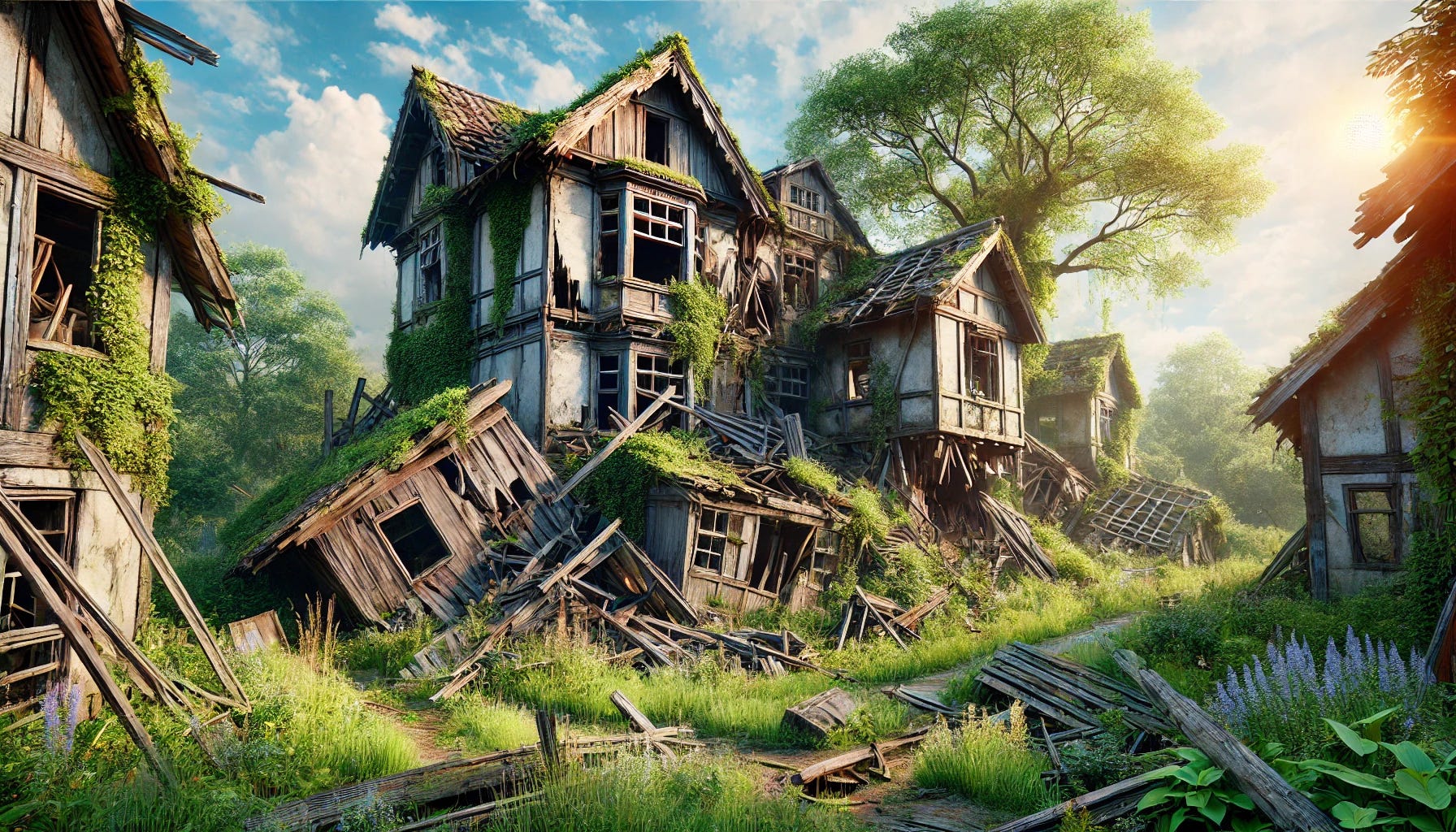
How does the biological world respond to the departure of humans from the countryside? Of course, the details vary from case to case but what Dr Daskalova and others have typically found is that, in a particular place, it is often take-over by single species, often invasive plants that may be relatively new to the country. The article describes long-abandoned houses in her village sinking into the ground and being covered in thick layers of brambles. In other areas, other plants take over. In Poland, another Eastern European country where there has been much abandonment of rural areas, a common exotic invasive plant in many abandoned fields is Canadian goldenrod. The latter is certainly colorful but it is nevertheless a weed and in areas it has taken over, it greatly reduces the biodiversity of those fields.
In effect, abandonment of countryside that was once worked by humans frequently leads to, effectively, monocultures of invasive plants. Monocultures are, by definition, the enemies of biodiversity. One sees this also, of course, in vast deliberately created monocultures, such as those of pine trees for timber in the North America or the plantations for producing palm oil in Indonesia or cattle farms in the Amazon, cleared to make pasture land for the cattle. The losses in such situations are irreparable, at least on the time scale of human life, and manifold in scope. Given the role of the Amazon as one of the important lungs of the world, supplying oxygen for the planet, deforestation there is a loss for the whole world, not just the indigenous peoples and the animals of the Amazon.
Even in smaller areas of rural abandonment, the longer such accidental plant monocultures persist, especially if they cover large areas, the greater the impoverishment of Nature and the more difficult its reversal. Soil gets depleted, making it harder for other plant species to come in. Animals that previously visited the area will do so less often. Of course, nothing lasts forever and even monocultures, especially those created accidentally by abandonment of the land, gradually erode, leading to a more biologically diverse landscape. Yet, at a time where destruction of the natural world seems to be far outpacing its restoration, even delays in recovery are harmful to the long-term health of Nature.
And rural abandonment has a further consequence. Such land, sooner or later, is reclaimed by humans but, usually, not for ecologically-sound farming but for industrialization. When that happens, it really is effectively the end for Nature in those places.
There are two major conclusions from these somewhat melancholy thoughts about what follows human abandonment of the countryside. One involves a correction of a long-held belief about the natural world, the second leads to a rather optimistic thought of what might be done.
The long-time belief, which was held in much of the 20th century but is rooted in older ideas of the harmony of Nature, is that Nature is inherently self-correcting, that in some sense, when disturbed, it tends to return to equilibrium. In terms of land that supports vegetation, this is related to the idea of a typical and even inherent drive toward a forest “succession”. In this scheme, when a forest is totally destroyed, such as by a major fire or eliminated to make fields or pastures initially, but then left alone, one will see a natural progression of plant forms. There will be first fairly small annuals, probably grass or clover too, then shrubs and bushes, increasingly longer-lived plants, and then small trees. The latter grow into bigger trees and make, eventually, a “mature” forest. Those trees will shut out much of the light that would otherwise reach the forest floor and thereby inhibit much growth of newer, smaller plants. Of course, the kinds of trees, animals, smaller plants, microbes and fungi, will differ from place to place, thanks to differences of climate, latitude, rainfall, etc. but the pattern – in this traditional idea – of succession will be basically the same.
These views were first elaborated by a mid-Western American botanist and ecologist, Frederic Clements (1874-1945). Clements was a thoughtful man and this is how he interpreted his observations about how perturbations of ecological disturbance were self-corrected. His views were influential in the then still fairly new science of ecology.2 Yet, they were soon meeting criticism from fellow biologists, especially ecologists, that Nature was more complicated than this. Some of their studies showed that certain kinds of ecological imbalance were not readily corrected but were followed by new trajectories of change, leading to new ecological states that were not standard succession or replicas of what had existed before.
Yet pioneers in new fields, especially if they are articulate and explain their views well, can have long-lasting influence even after their ideas have begun to fail. Clement’s influence affected a major 20th century figure in ecology, G. Evelyn Hutchinson (1903-1991). Hutchinson was English by birth, grew up in Cambridge, England and got his Ph.D. there. Soon after receiving his doctorate he took up an initial temporary position at Yale University in New Haven, Connecticut. He would be there the rest of his life and became not just a remarkable scientist but a gifted, dedicated teacher, beloved by many students over more than five decades. Though his lifetime was nearly co-extensive with the 20th century, he was more like a 19th century scientist in the rare mold of Alexander von Humboldt and Charles Darwin, given his breadth of interests and depth of insight. For instance, he was one of the first to warn about the dangers of global warming, in 1949, decades before any but a handful of people saw what a big potential problem for the planet this was.
Hutchinson was, at first, a strong believer in Clements’ ideas on natural equilibria and a universal mode of succession in ecological systems. From his studies, however, especially on lakes as ecological communities (he essentially founded this branch of study, limnology), he soon began to question those ideas and reject them. He came to see dynamic change and, at most, temporary quasi-stability as the rule for ecosystems rather than fixed succession patterns and equilibria. Some of his gifted students would carry on these studies, and expand these insights, with a whole battery of new methods and new forms of analyses.3
What might Hutchinson have thought of the new data showing that following rural depopulation, forests and fields do not return to their prior biological compositions and ecologies? One can only guess but I think the safe bet is that he would not have been surprised at all. Indeed, the general picture of new ecosystem states emerging in such areas is exactly what he would have predicted.
I mentioned earlier an optimistic, indeed encouraging, thought that is emerging from the new studies of deserted rural areas. That idea is that human presence can promote increased biodiversity. In other words, we humans are not just agents of increasing destruction of the natural world but have acted as agents that promote increased biodiversity. In fact, there is a whole new set of studies on ancient communities around the world, from the Amazon to the Arctic tundra where the evidence suggests that humans were already having an impact, and not a destructive one.4 In fact, non-industrialized farming – and clearly early agricultural practices were small scale and not anything like industrialized farming today – is known to promote biodiversity.
Couple these observations with what is being done to “green” modern cities – more capture of sunlight for energy, more rooftop gardens, fewer autos, reclaimed city rivers, more parks, and more – and one begins to see human potential for strengthening Nature. And the current science of ecology is rapidly expanding our knowledge of the dynamism of ecosystems, far beyond the older notions of ecology; these are exciting findings.5
These last points, I feel, are positive notes on which to end this article.
See Tess McClure (2024). The call of Nature. The Guardian, long read, 6 Dec., pp. 34-39
The science of ecology began with certain observations of Alexander von Humboldt, the German thinker and explorer of South America, who was an inspiration for Darwin. The word “ecology” was coined by Ernst Haeckel, Darwin’s chief German disciple, in 1868, and was meant to designate a companion field to that of evolution but did not become a real field of research until the 20th century.
A good but short article on G. Evelyn Hutchinson is Lynch, P. (2015). Ecology, evolution & climate change. Yale News, news.yale.edu/2015/11/21/
Some discussion of these findings of ancient human civilizations and their ecological effects are found in the article by McClure (note 1)
A good brief review of current ideas on ecological succession is Chang, C.C., Turner, B.L. (2019). Ecological succession in a changing world. Doi:10.1111/1365-2745.13132
Hi David, Many thanks for your comment. I do feel that the more species that share an "ecospace" (all the interactions they can have with each other in a particular place) the less each one tends to determine what happens in that ecospace, hence the more resistant the system is to huge loss if any one species disappears. Of course, there are so called "keystone species" (a term and an idea formulated in 1969) which play a disproportionate role in their ecosystem but, in general, the more interacting species there are, the stabler the whole system is to loss of any one. Some quantitative analysis and mathematics has been done on this. I have read (this is attributed to EO Wilson) that the number of species that an area can support is, on average, something that scales to the power to the fourth of the area. But of course this must be a function of the climate and ecological specifics; almost certainly the Sahara and the Amazon forest will be different in this respect. Still, it is good to know that scientists are trying to work out these relations.
More diversity in nature increasing resilience seems obvious, perhaps why I haven't heard it mentioned before, but is such a great argument for it. Embarrassingly, I not put the puzzle pieces together myself, great!